When sensitive conversations happen in Canberra, the privacy stakes are often higher than they first appear. A leadership meeting in a boardroom, a confidential call in an office, or a strategy discussion in a vehicle can involve commercial secrets, personnel issues, legal advice, procurement decisions, or government-facing work. At the same time, the Australian Signals Directorate’s Annual Cyber Threat Report says malicious state actors and cybercriminals continue to adapt their tradecraft against Australian governments, critical infrastructure, businesses, and households. (Cyber.gov.au)
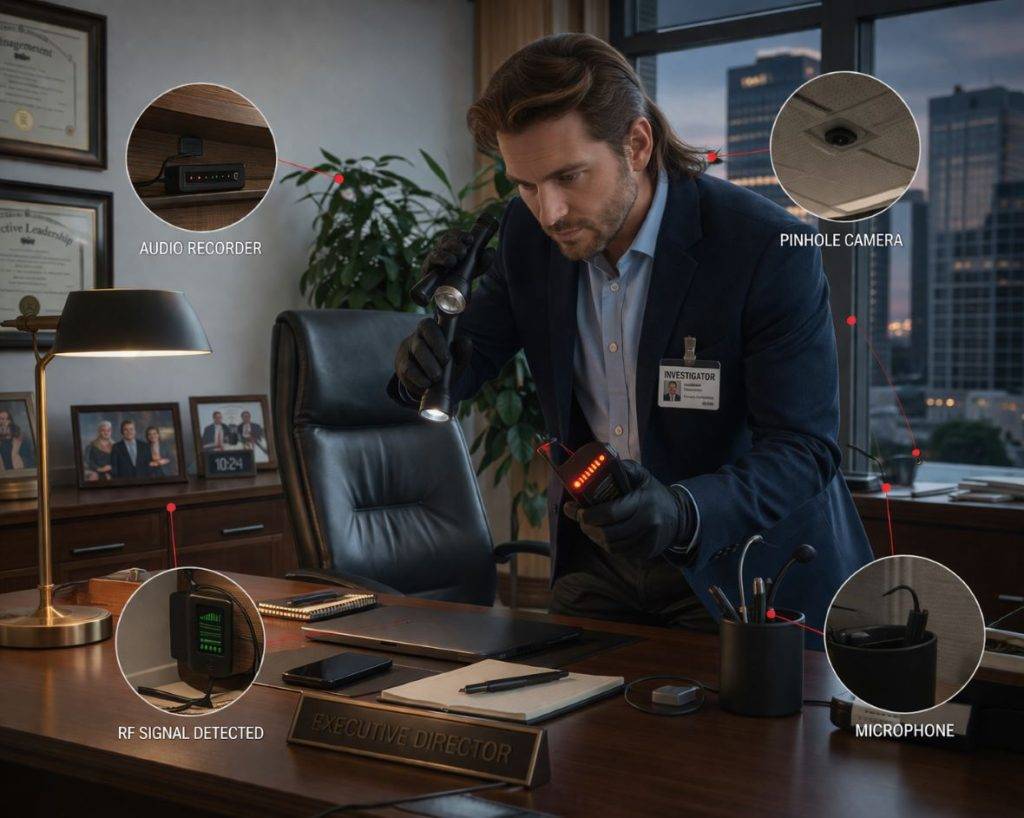
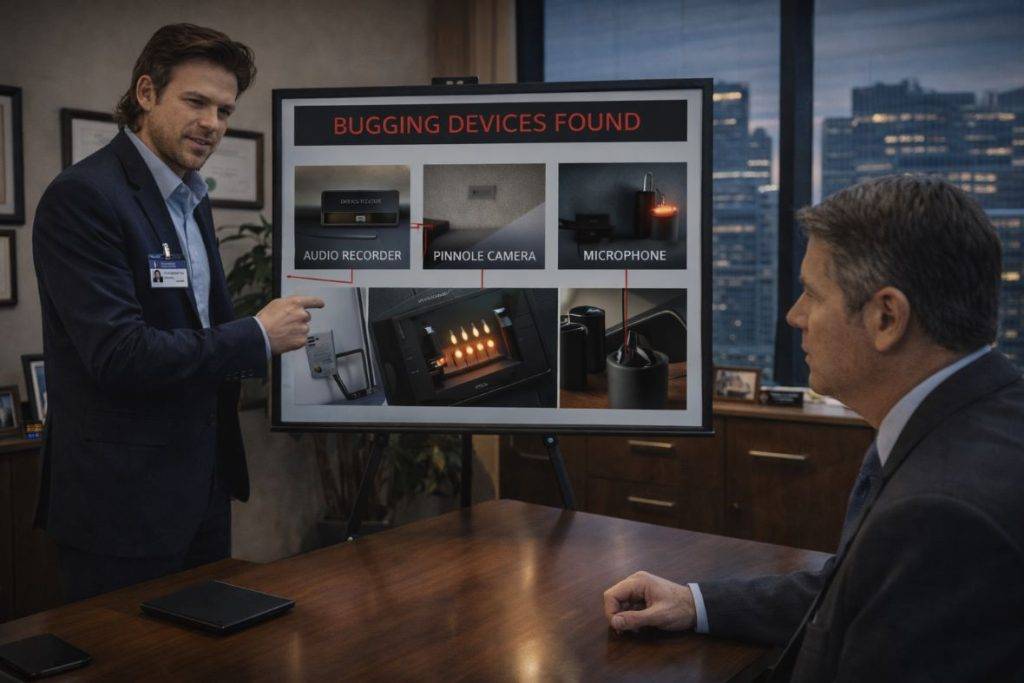
That is why bug sweeps or counter-surveillance services matter. In practical terms, a bug sweep is a technical and physical inspection designed to detect signs of unauthorised surveillance, tracking, or data capture. In Canberra workplaces, that usually means looking for hidden audio devices, concealed cameras, suspicious wireless hardware, rogue network gear, vehicle trackers, and signs that rooms, fittings, or equipment have been tampered with. The legal side matters too. In the ACT, private conversations, workplace monitoring, covert surveillance, and tracking devices are all regulated, so a useful sweep is not just about finding a device. It is also about understanding what can lawfully be monitored, what may have been done unlawfully, and how to respond without creating a second problem.
Why Canberra offices, boardrooms, and vehicles carry a higher privacy risk
Canberra is not just another office market. It is a city where executive meetings often overlap with legal, policy, security, procurement, association, consulting, and contractor work. That does not mean every office faces espionage-level risk. It does mean the cost of information leakage can be unusually high. The ACSC’s Information Security Manual states that organisations should apply a risk management framework to protect systems and data from cyber threats, and it specifically provides guidance on governance, physical security, personnel security, and information and communications technology security.
Privacy risk also increases when organisations assume that visible CCTV equals full security. The ACT Government’s own CCTV policy says cameras are used in facilities, vehicles, and open spaces for safety, traffic, and asset monitoring, while also recognising the privacy implications and the need to balance purpose with the right to privacy. That is a useful distinction. Overt CCTV can be legitimate. Hidden surveillance, rogue tracking, or unauthorised recording is a different issue altogether. (Justice and Community Safety Directorate)
What a bug sweep is actually looking for
A good bug sweep does not focus on one gadget. It looks at categories of risk. In the ACT, those categories are reflected in the legal framework itself. The Listening Devices Act deals with private conversations. The Workplace Privacy Act separately regulates optical surveillance devices, data surveillance devices, and tracking devices in workplace settings. Taken together, those categories are a useful practical map for what a sweep should test.
In practice, that means a sweep may look for:
- hidden microphones or standalone audio recorders
- concealed cameras or disguised optical devices
- GPS or other location-tracking hardware in vehicles or assets
- rogue Wi-Fi, Bluetooth, or RF-emitting devices
- unauthorised data-capture hardware connected to office systems
- physical signs of tampering in boardrooms, vehicles, power points, meeting hardware, or communications equipment
The device itself is only part of the answer. The wider question is whether the environment has been set up to capture conversations, movements, or data without proper authority.
Hidden microphones and private-conversation risks
In Canberra, boardrooms and executive offices are often treated as routine business spaces, but that does not mean privacy is stripped away. The ACT’s Listening Devices Act makes it an offence to use a listening device to listen to or record a private conversation if you are not a party to it, and it also restricts a party recording a private conversation unless consent or a recognised exception applies. The Act also creates offences around communicating or possessing unlawfully recorded private conversations.
That matters because one of the most common executive assumptions is that the real issue is whether a device is “sophisticated.” Legally, the issue is often much simpler. If a private conversation is being captured without proper authority, the fact that the device is small, cheap, or hidden inside something ordinary does not make it harmless. A sweep in an office or boardroom is therefore as much about identifying unlawful audio risk as it is about finding a single “bug.”
Hidden cameras and optical surveillance in offices and boardrooms
Not all privacy threats are audio-based. The ACT Workplace Privacy Act says employers may only conduct optical surveillance of workers using an optical surveillance device if the device is clearly visible and signage is clearly visible at each entrance telling people they may be under surveillance. The Act also prohibits surveillance in certain non-work areas such as toilet facilities, change rooms, showers, parent or nursing rooms, prayer rooms, sick bays, and first-aid rooms.
That gives Canberra organisations a useful working rule. A bug sweep is not only looking for “spy cameras” in the dramatic sense. It is checking whether cameras, camera housings, or related equipment are where they should be, whether they are overt or concealed, and whether any device placement clashes with the privacy expectations of the space. In a boardroom, even a hidden visual device with no audio can be a serious breach if it captures strategy discussions, commercial documents, or participants in circumstances where they reasonably expected confidentiality.
Vehicle trackers and location intelligence
Executive privacy risk does not stop at the office door. Vehicles are often overlooked even though they can reveal movements, routines, meeting locations, and contact patterns. The ACT Workplace Privacy Act defines a tracking device broadly as an electronic device capable of being used to work out or monitor the location of a person or object or the status of an object, with examples including GPS, biometrics, and RFID. The same Act says an employer may only conduct tracking-device surveillance of a worker through vehicle or item tracking if there is clear notice on the vehicle or thing, or if notice on the item is not reasonably practicable and workers have been reasonably notified.
For executives, that means a vehicle sweep can be one of the most practical steps in a privacy-risk review. It can reveal whether a company vehicle, pool vehicle, or privately used work-linked vehicle has been fitted with a tracker, whether the device appears authorised, and whether any tracking practice matches workplace notice and policy obligations. It also helps separate legitimate fleet or asset tracking from covert location monitoring that could become a legal or reputational issue.
Rogue wireless, Bluetooth, and network-connected devices
Modern privacy threats are not limited to classic listening hardware. Some risks come from unauthorised data-surveillance devices or wireless-enabled equipment placed in a room or attached to existing infrastructure. The ACT Workplace Privacy Act specifically regulates workplace surveillance using data surveillance devices and requires it to be conducted in accordance with a workplace policy, with prior worker notification. The OAIC also notes that if an employer keeps a record of workplace monitoring, such as CCTV video or computer records, the Australian Privacy Principles may apply.
That is why a boardroom sweep now often includes more than RF detection. It may involve checking for unknown wireless signals, unexpected Bluetooth devices, suspicious add-on hardware near displays or conferencing systems, and unauthorised technology attached to network or power infrastructure. The reason is straightforward: if a room’s data path or meeting technology has been altered, a privacy breach may occur without anyone noticing an obvious “bug” at all.
What a bug sweep can find in a Canberra boardroom
In a boardroom setting, the practical value of a sweep usually falls into four categories.
First, it can identify unauthorised hardware. That includes hidden audio devices, miniature optical devices, rogue wireless equipment, and unusual attachments to communications or AV systems. Second, it can identify environmental weaknesses such as poor room control, insecure equipment placement, blind spots, or easy-to-misuse meeting technology. Third, it can highlight policy gaps, especially where overt surveillance, digital monitoring, or conferencing systems are operating without clear notice or clear purpose. Fourth, it can help preserve decision-making confidence. In Canberra, where the same room may host commercial strategy, HR matters, legal discussion, and stakeholder negotiation, certainty about the room matters. (Justice and Community Safety Directorate)
What a bug sweep can find in executive offices
Executive offices create a slightly different risk profile. They are more likely to involve repeated confidential calls, private document handling, one-to-one meetings, and informal conversation that never reaches the boardroom agenda. A sweep may therefore focus not just on hidden devices but on how the office is being used: whether overt cameras nearby capture more than intended, whether office technology has been altered, whether the space is vulnerable to incidental audio leakage, and whether records created by surveillance or monitoring are being handled as personal information. OAIC guidance says collection of personal information can include surveillance-camera footage where an individual is identifiable or reasonably identifiable. (OAIC)
That point is often missed. In privacy terms, it is not only the hidden device that matters. It is also what happens to the footage, logs, or records once they exist.
What a bug sweep can find in vehicles
Vehicle sweeps are particularly useful where executives travel between offices, meeting sites, law firms, contractors, airports, and stakeholder locations. A sweep may locate suspicious tracking hardware, signs of physical tampering, hidden power-draw devices, or modifications that suggest the vehicle has been used as a monitoring point. In a Canberra context, that matters because vehicles often carry more than people. They carry routines, contact patterns, and route history. The ACT legal framework’s treatment of tracking devices makes clear that location monitoring is not a trivial issue.
The line between lawful monitoring and unlawful intrusion
One of the most valuable things a bug sweep can do is help an organisation stop confusing lawful monitoring with privacy-safe practice. The OAIC says workplace monitoring must comply with Australian, state, and territory laws. In the ACT, visible workplace optical surveillance requires visible devices and signage, data surveillance requires policy and notification, and worker surveillance when the worker is not at work is generally prohibited, with limited exceptions such as monitoring employer-provided equipment or resources. (OAIC)
The covert-surveillance rules are tighter still. Under the ACT Workplace Privacy Act, an employer commits an offence if it conducts covert surveillance of a worker in a workplace without a covert surveillance authority. The Magistrates Court, when considering whether to issue such an authority, must weigh the seriousness of the suspected unlawful activity, the extent of the privacy intrusion, whether there are other appropriate ways to find out what is happening, and whether law enforcement would be a more appropriate avenue. A covert surveillance authority may be issued for no longer than 30 days unless another period is prescribed.
That matters for any Canberra executive or employer considering an internal response. A bug sweep is lawful risk assessment. Secretly escalating to unlawful monitoring is something else.
When to consider a bug sweep
A Canberra organisation should usually think about a sweep when one or more of the following is true:
- sensitive discussions are recurring in the same office, boardroom, or vehicle
- there has been a leadership dispute, procurement concern, or suspected information leak
- confidential matters involve government-facing, legal, commercial, or security-sensitive work
- a vehicle, room, or meeting setup has been accessed by people outside the normal control chain
- there are signs of tampering, unexplained wireless activity, or unexplained disclosure of private matters
- an executive believes their movements or meetings are being anticipated too accurately
The reason is not fear for its own sake. It is proportionality. If the privacy risk is real, an early technical check is often cheaper and cleaner than waiting for a pattern of leakage to become a formal crisis. (Cyber.gov.au)
Conclusion
A bug sweep in Canberra is not just about finding hidden gadgets. It is about testing whether a confidential space remains confidential. In offices, boardrooms, and vehicles, the real value lies in identifying unauthorised surveillance, clarifying whether existing monitoring practices are lawful, and closing the weak points that expose conversations, movements, or data.
For executives and organisations, that makes a sweep both a privacy check and a control check. In a city where sensitive work often overlaps with legal, policy, commercial, and government-facing risk, certainty about your environment is not overreaction. It is part of good governance.
FAQs
1. What can a bug sweep actually detect in an office or boardroom?
A bug sweep can help detect signs of hidden audio devices, concealed cameras, rogue wireless or Bluetooth hardware, suspicious tracking-related equipment, and physical tampering around meeting-room technology, power points, fittings, or communications infrastructure. In practice, the inspection scope usually reflects the categories of listening, optical, data, and tracking devices recognised in ACT law.
2. Are hidden cameras and audio devices treated the same way in the ACT?
Not exactly. Private conversations are regulated under the ACT Listening Devices Act, while workplace optical, data, and tracking surveillance are separately regulated under the Workplace Privacy Act. That means the legal issues can differ depending on whether the risk is audio recording, video capture, data monitoring, or location tracking.
3. Can an ACT employer secretly monitor staff if they suspect misconduct?
Usually not without a very careful legal footing. The Workplace Privacy Act states that covert workplace surveillance generally requires a covert surveillance authority, and the Magistrates Court must consider the seriousness, privacy intrusion, alternatives, and whether law enforcement is more appropriate. Evidence obtained through covert surveillance also faces limits on admissibility.
References
Australian Signals Directorate. Annual Cyber Threat Report 2023-2024. (Cyber.gov.au)
Australian Signals Directorate. Information Security Manual.
Australian Capital Territory. Listening Devices Act 1992.
Australian Capital Territory. Workplace Privacy Act 2011.
ACT Justice and Community Safety Directorate. Closed-Circuit Television (CCTV) Policy. (Justice and Community Safety Directorate)
Office of the Australian Information Commissioner. Australian Privacy Principles guidelines. (OAIC)
Office of the Australian Information Commissioner. Workplace monitoring and surveillance. https://aifs.gov.au/resources/policy-and-practice-papers/what-research-evidence-tells-us-about-coercive-control