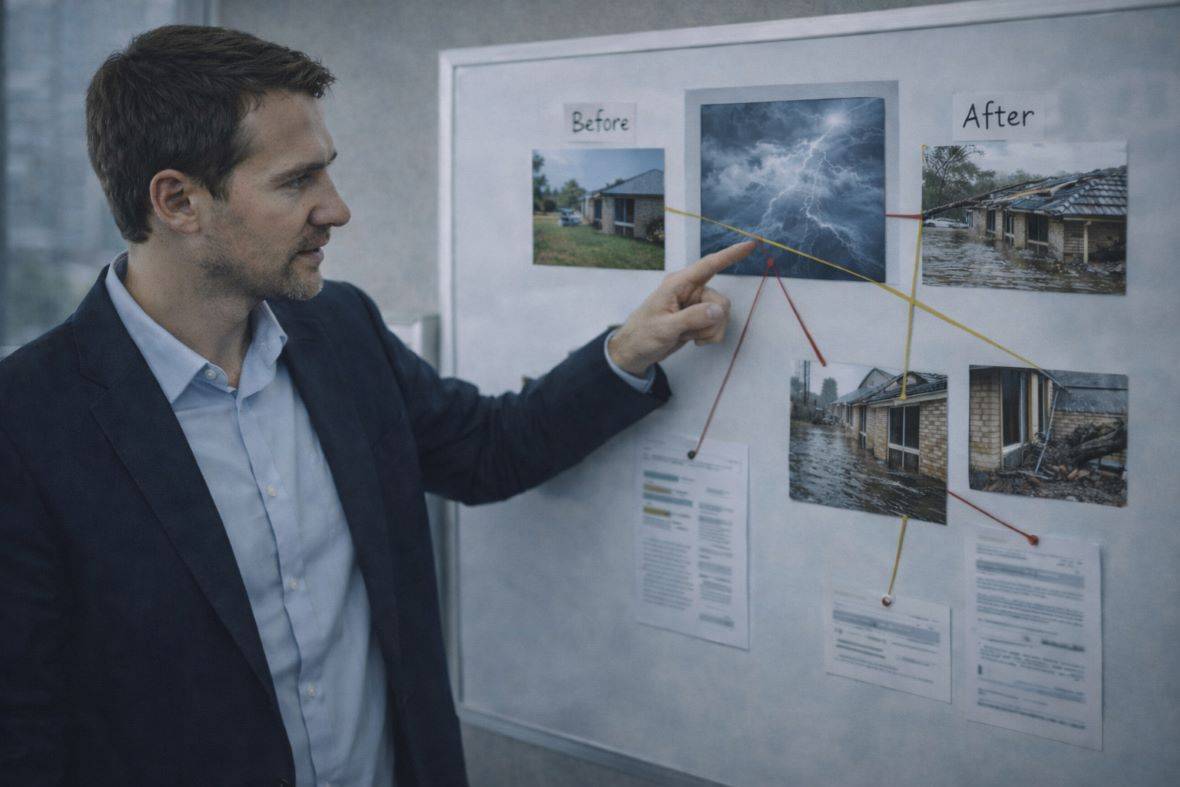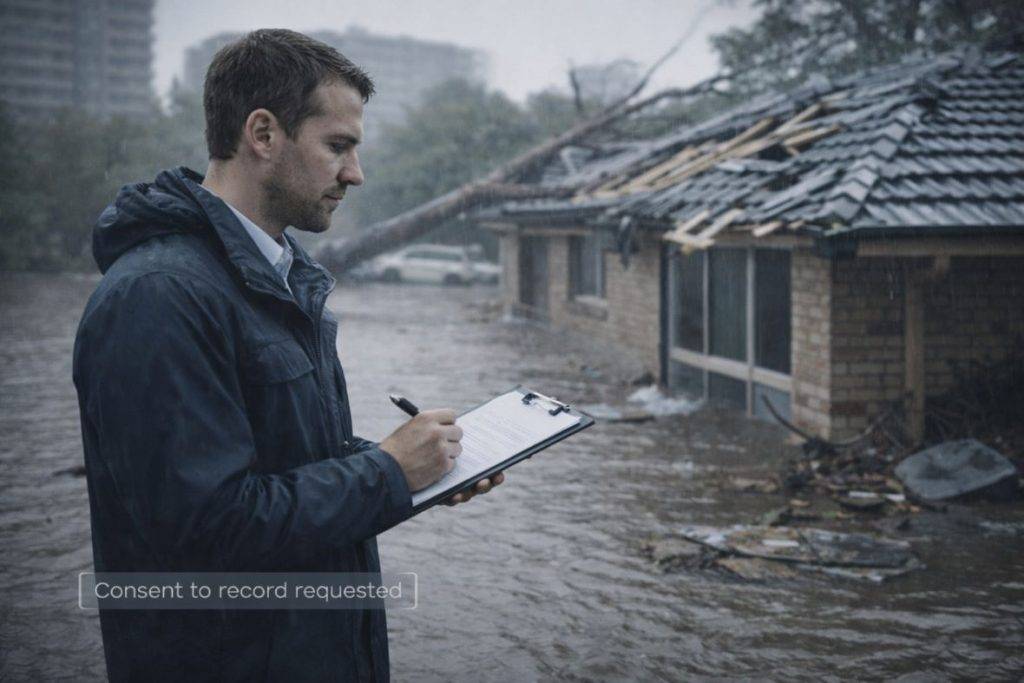
When a major storm hits Sydney, the aftermath can look like a battlefield, with broken tiles, fallen branches, water intrusion, and frantic phone calls. During catastrophe periods, insurers can be dealing with claim volumes in the hundreds of thousands across Australia, which is why verification workflows become more structured and evidence-driven.
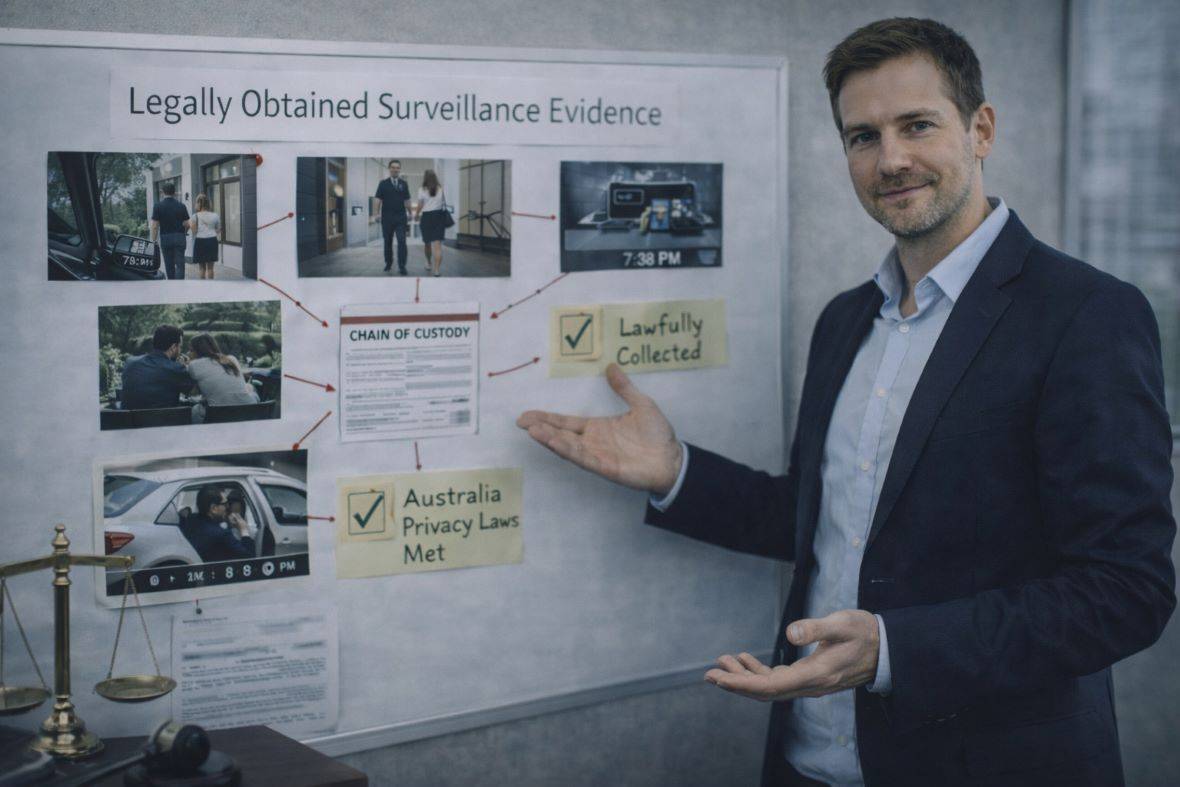
To manage that surge fairly, insurers sometimes engage private investigators in Australia and specialist assessors to document what happened on-site and test whether the damage aligns with the reported event. These checks aren’t automatically an accusation. They’re a way to separate storm-caused loss from pre-existing issues, exaggerations, or unrelated damage—so legitimate claimants aren’t competing with noise.
Why Insurance Companies Hire a Private Investigator After a Sydney Storm
Large weather events create an “all at once” effect: thousands of claims, limited assessor capacity, and a small percentage of people trying their luck. Australia’s insurance peak body describes insurance fraud as ranging from exaggerating otherwise legitimate claims to intentional misrepresentation and organised manipulation.
There’s also a long-standing pattern of insurers outsourcing parts of fraud and verification work: the Australian Institute of Criminology has noted a substantial increase over time in using private investigation services to investigate suspected insurance fraud.
Just as importantly, an insurer’s investigation should still be relevant and reasonable. Consumer legal guidance notes that insurers are entitled to investigate claims, and claimants generally need to cooperate with reasonable enquiries for the claim to progress.
Identifying Pre-Existing Damage and Wear
A key task is timing: when did the damage occur? Investigators look for indicators that suggest long-term deterioration rather than sudden storm impact, patterns like older rust staining, prolonged moisture pathways, repeated patching, or biological growth consistent with time.
This part of the process matters because many policies draw a line between sudden insured events and gradual wear, defects, or maintenance issues. (This varies by policy wording, so it’s assessed case-by-case.)
Spotting Intentional Damage for Larger Payouts
Sometimes the inspection is about whether the damage pattern matches how storms behave.
Hail strikes from above; wind damage tends to follow directionality and uplift mechanics; debris impact usually has collateral signs. Investigators look for mismatches like uniform “hail dents” with tool-like spacing, pry marks that don’t fit wind uplift, or damage confined to one claim-critical area with no surrounding indicators.
In NSW, knowingly making a false claim can escalate beyond an insurer dispute into criminal territory. Fraud under s 192E of the Crimes Act 1900 (NSW) includes dishonestly obtaining a financial advantage by deception and carries serious maximum penalties.
The Step-by-Step Inspection Process on the Ground
Most storm-damage verification follows a disciplined routine:
- Claim narrative check (what the insured says happened, when, and where)
- Perimeter walk (looking for consistency across rooflines, gutters, fences, outbuildings)
- Close-up documentation (impact points, water entry paths, broken fixings, debris fields)
- Corroboration (neighbour observations, local conditions, storm timing)
- Report write-up (what was observed, what was provided, and what can be supported)
If you’re being investigated, it helps to stay calm and provide originals where possible (photos, repair invoices, timestamps). Consumer guidance emphasises credibility and consistency, and that investigations should be relevant to the claim.
Using High-Resolution Photography and Drones
Modern claims verification often uses high-resolution imaging—especially for roofs, ridgelines, and upper elevations where ladder access is risky.
If drones are used, they must be operated under Australia’s aviation rules. CASA explains that drone operations fall under CASR Part 101, and that flying a drone for work/business requires compliance steps (such as registration and operator accreditation or licensing, depending on the type of operation).
This isn’t just “cool tech.” Research literature shows that UAVs can support safer, more efficient roof inspection and damage assessment workflows by capturing high-resolution imagery without putting people on unstable roofs.
Investigators typically aim for:
- wide context shots (entire roof planes),
- then close-ups (hail hits, tile displacement, flashing separation),
- plus timestamped notes that link images to claim assertions.
Interviewing Neighbours and Checking Local Weather Data
Site evidence is often paired with official weather verification.
In Australia, the Bureau of Meteorology provides:
- Climate Data Online (historical observations/statistics from weather stations),
- and a Storm Confirmation tool that can confirm thunderstorm/lightning and/or strong winds within a defined radius and date range (useful for validating that storm signals were present near the claimed time/location).
Neighbour interviews also help build a street-level timeline—hail size reports, wind timing, the sequence of impacts, especially when multiple properties in the same micro-area show similar damage.
Why this matters in Sydney: hail and extreme weather drive big insured losses
Storm and hail events are not “small” in insurance terms. Research has found that hailstorms account for a substantial share of insured losses in Australia over the long term, and recent industry reports show that extreme weather claims can total billions of dollars in a single year.
That’s a big reason insurers apply structured verification: the goal is fast, fair triage that pays genuine claims while filtering out mismatches.
Investigation steps at a glance
| Investigative Step | Purpose of the Action | Common Tool Used |
| Perimeter Walk | Finding consistent damage patterns | Digital Camera |
| Aerial View | Inspecting the roof and chimney safety | 4K Drone |
| Weather Check | Verifying storm severity in the area | BOM Records |
| Neighbor Chat | Confirming the time of the event | Verbal Interview |
This table shows how different methods come together to form a complete picture. Each step provides a different layer of proof for the final report.
Real-world examples of storm damage verification
Example A: Evidence aligns (claim supported)
A tree strike claim shows fresh break points, green leaf debris, consistent collateral damage (fence + roof), and nearby residents confirm the timing. BOM indicators show storm activity in the area during the claimed window.
Example B: Evidence doesn’t align (claim challenged/denied)
A “hail destroyed my tiles” claim shows repeated uniform marks on tiles but no corresponding impact on nearby items that typically show hail signatures. BOM data indicates only light conditions locally for the stated time. The investigator documents the inconsistency and flags it for the insurer’s decision-making.
Insurance Check
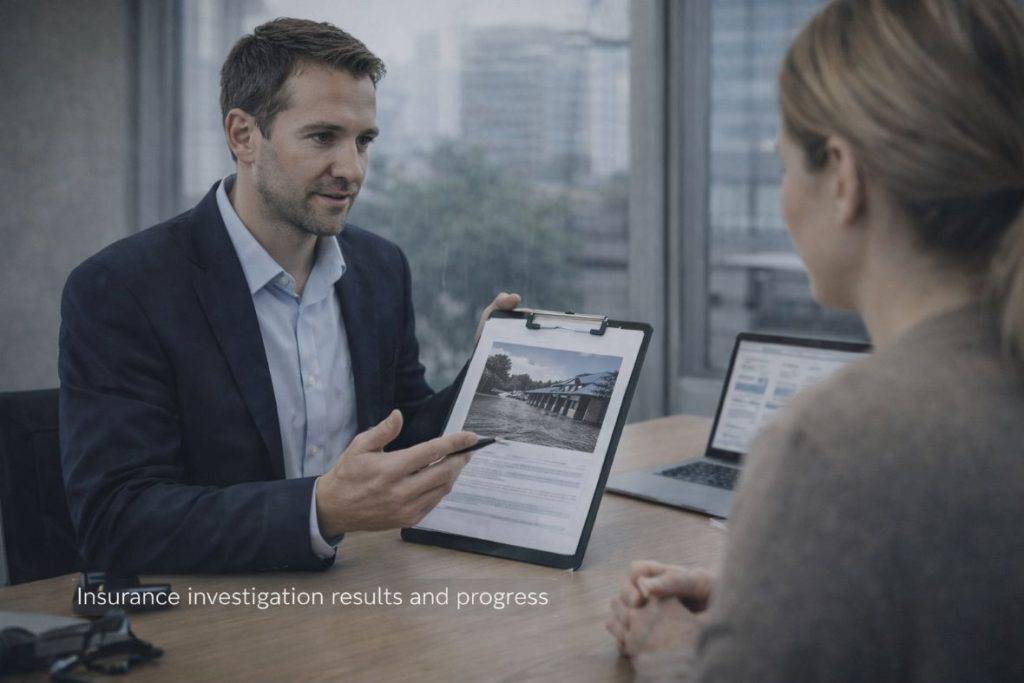
A Private Investigator plays a vital role in the Sydney property market. They aren’t there to stop you from getting paid; they’re there to make sure the facts are accurate. By using drones, weather data, and expert observation, they create a clear picture of what happened during the storm. Being honest and transparent is always the best way to handle any Insurance matter. If your damage is real, the evidence will speak for itself. Ultimately, these professional checks keep Sydney homes safer and help the entire system stay reliable for everyone when the next big storm hits.
Frequently Asked Questions About Insurance Investigations
You might have a few lingering questions if you’re waiting for an investigator to visit your home. Most people feel a bit nervous, but knowing what to expect can help ease that tension.
Does every storm claim get a Private Investigator?
No, most minor claims are handled by a standard adjuster. A company usually calls in a specialist for very large payouts, complex structural damage, or when the initial photos look suspicious.
Can I refuse to let them on my property?
You have the right to refuse entry; however, doing so will likely result in the company denying your claim. Most policies require you to cooperate with the investigation as a condition of getting paid.
How long does the investigation take?
The physical visit usually lasts between one and three hours. After that, the Private Investigator needs a few days to a week to finalise their report and send it to the insurer.
References
Australian Institute of Criminology. (n.d.). Private investigators in Australia. https://www.aic.gov.au/crg/reports/crg-1599-00
Bureau of Meteorology. (n.d.). Climate Data Online. https://www.bom.gov.au/climate/data/
Bureau of Meteorology. (n.d.). Storm confirmation. https://www.bom.gov.au/climate/storms/
Civil Aviation Safety Authority. (n.d.). Drone safety rules. https://www.casa.gov.au/drones/drone-rules/drone-safety-rules
Civil Aviation Safety Authority. (n.d.). Part 101 of CASR: Unmanned aircraft and rockets. https://www.casa.gov.au/rules/regulatory-framework/casr/part-101-casr-unmanned-aircraft-and-rockets
Crimes Act 1900 (NSW) s 192E. https://www5.austlii.edu.au/au/legis/nsw/consol_act/ca190082/s192e.html
Financial Rights Legal Centre. (n.d.). Insurance investigations. https://financialrights.org.au/factsheet/insurance-investigations/
Insurance Council of Australia. (n.d.). Insurance fraud. https://insurancecouncil.com.au/consumers/insurance-fraud/
Insurance Council of Australia. (2026, January 23). Extreme weather cost $3.5 billion in 2025 (news release). https://insurancecouncil.com.au/resource/extreme-weather-cost-3-5-billion-in-2025/
Raupach, T. H., & Aldridge, J. (2025). Changes in hail damage potential in major Australian cities… Geophysical Research Letters. https://agupubs.onlinelibrary.wiley.com/doi/10.1029/2025GL117676