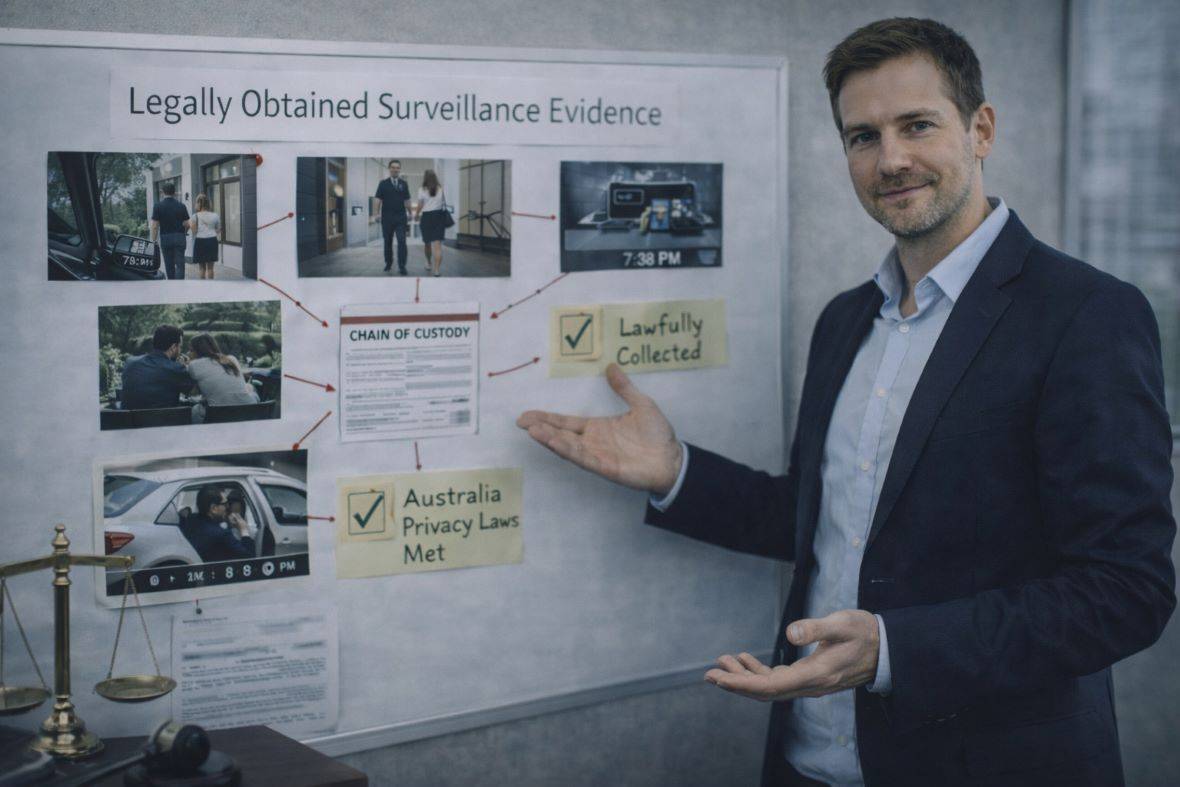
When stock vanishes, cash totals don’t match, or tools keep “walking off site,” you’re not just losing money, you’re risking trust. A Private Investigator can help you understand what’s happening, who had access, and provide clear, lawful evidence to support your decisions.
In Australia, that help has to stay inside the rules. You want clear facts and usable evidence, but it must be gathered lawfully, or it can backfire fast. Loss and theft issues show up everywhere, on retail floors, in warehouses, in offices, and on construction sites, often in the same patterns.
Act early. Evidence fades like footprints in sand. CCTV footage is overwritten, receipts go missing, and stories change once people sense scrutiny. If you suspect fraud or internal theft, a calm, planned response gives you the best chance of getting answers you can rely on.
What a Private Investigator can (and can’t) do in an Australian loss and theft investigation

A Private Investigator can help you observe, document, and verify. They can map routines, identify weak points, and test whether the loss matches a pattern (time of day, staff roster, delivery schedule, refund activity). They can also help you build a brief that makes sense to decision-makers, insurers, and, sometimes, the police.
Highlight that private investigators must operate within legal boundaries by clarifying they cannot ‘go rogue’ when situations feel urgent, ensuring readers understand lawful practices in loss and theft investigations.
- They can conduct discreet observation from lawful public vantage points or from areas where you have permission to operate.
- They can collect statements from willing witnesses and preserve a clear record of what was said and when.
- They can review publicly available open-source information and compare it with your internal records.
On the other hand:
- They can’t trespass onto private property to get a better view.
- They can’t illegally record private conversations or intercept calls.
- They can’t break into devices, accounts, or systems to pull messages or transaction data.
Stress that verifying current licensing is crucial because recent reforms and tighter checks (noted across [2025 to 2026]) mean you should confirm the investigator’s valid private security licence, helping readers identify reputable provider should confirm licensing status and explain the lawful plan in plain language. If you want a simple starting point on boundaries, legal boundaries for private investigators in Australia.
Legal evidence gathering, what surveillance and undercover work look like
In loss and theft matters, surveillance is usually made to look boring on purpose. It’s watching entry points, noting who handles keys, tracking timing around cash-ups, deliveries, or refund spikes, and documenting repeat movements.
Specify that lawful video is permitted only where the investigator has the right to film from that position, and undercover work should focus on observation and factual reporting, not entrapment, to clarify lawful surveillance practices for readers.
What you should never expect in a lawful investigation includes hidden listening devices, call interception, hacking, forcing access to staff-only areas without permission, or sneaking onto private property.
A good investigator keeps an evidence trail you can explain later: contemporaneous notes, time stamps, exhibit labels, and a clear record of how each photo or observation was captured.
Privacy and recording rules that shape the investigation plan
Australia has strong privacy protections, and mishandling personal information can pose risks to you and the investigator. This shapes practical decisions like where cameras can be placed, what can be recorded, how interviews are conducted, and how data is stored and shared.
If the plan feels like it depends on “secret recordings” or questionable access, stop and reset. Evidence that’s obtained unlawfully can weaken your options, even if your suspicions are correct.
How loss and theft investigations are conducted, step by step, from first call to final report
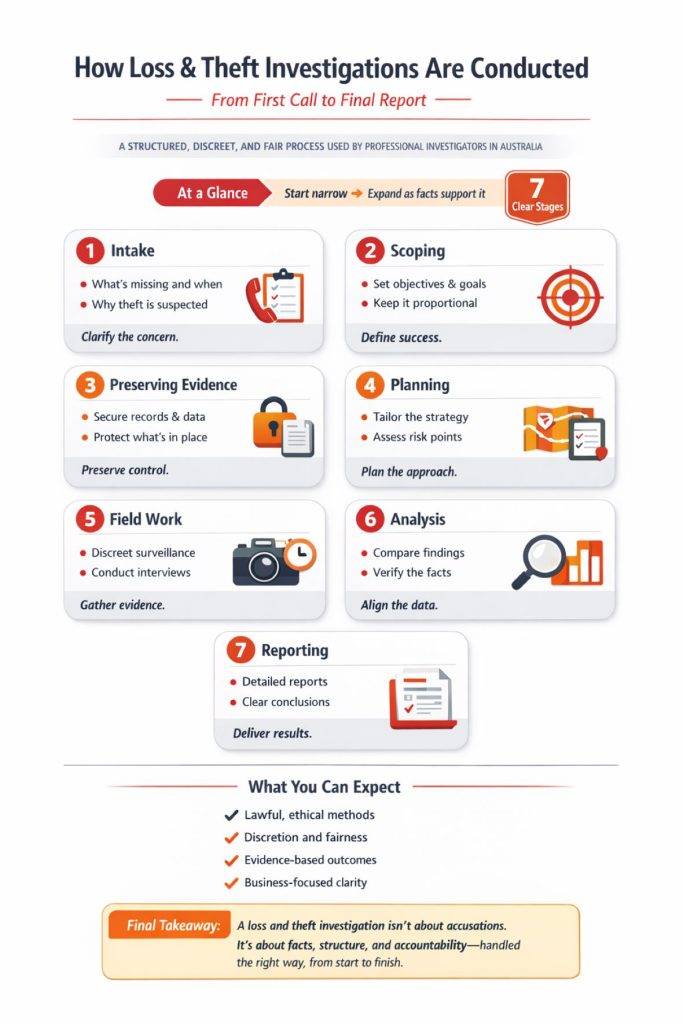
A solid investigation is structured, discreet, and fair. You should expect a process that starts narrow (what’s missing and when), then expands only as facts support it.
Most cases follow seven stages: intake, scoping, preservation, planning, field work, analysis, and reporting.
Intake: You explain what’s missing (stock shrinkage, missing petty cash, fuel cards, tools, or suspicious refunds) and why you suspect theft or fraud.
Scoping: The investigator helps you define what success looks like. Are you trying to stop ongoing losses, identify a person, support internal discipline, back an insurance position, or prepare a brief for legal advice?
Preserving evidence: Before anything else, you secure what you already control. That may include locking down point-of-sale logs, isolating inventory adjustments, saving CCTV exports, and restricting system admin access. It’s often the difference between a clean case and a messy one.
Planning: The investigator designs a lawful plan for your site and risk points in a warehouse, focusing on dispatch bays and after-hours access. In retail, it might centre on refund activity and voids. On a construction site, it might track tool storage, deliveries, and who signs items out.
Field work: Surveillance is scheduled for times when losses are likely to occur, not on random days. Interviews are arranged discreetly, with care not to spook staff or tip off a suspect.
Analysis: Observations are matched against your records. For example, cash skimming is checked against till reconciliation, false refunds are compared to receipts and customer data you lawfully hold, and missing stock is tested against delivery dockets and cycle counts. Expense fraud might be reviewed through claims, approvals, and timing patterns.
Reporting: You receive a clear report with a timeline, exhibits, and conclusions tied to facts, not guesses. If there’s a broader business risk, you may also be given control fixes. For context on business-focused investigative work, we would have comprehensive business investigation services in Australia.
Intake and scoping, how you define the loss, risks, and objectives
You’ll be asked direct questions: What exactly is missing, how often, and what’s the estimated value? When did it start? Who had access, keys, passwords, alarm codes, vehicles, cards, or supervisor approvals? What systems exist (POS, inventory software, access cards, GPS, job logs), and who administers them?
Before the first meeting, gather a tight pack of basics: a short incident timeline, shift rosters, relevant policies (cash handling, refunds, stock adjustments), photos of affected areas, and any prior audit notes. Keep it simple; the goal is clarity, not a document dump.
Field work and evidence handling, what happens during surveillance and interviews
Surveillance plans are chosen around locations, sight lines, entry points, and timing. The investigator records what they see with lawful photos and video, where permitted, and written notes that include dates and times.
Evidence handling matters because you may need to show that items weren’t altered. That “chain of custody” approach applies to exported CCTV, documents, and physical exhibits.
Interviews are handled carefully. You should expect a neutral tone, open questions, and no intimidation. The point is to gather reliable information, not to force a confession. If facts point to criminal conduct, you may be advised to involve the police, while the investigator stays focused on documentation and a clean brief.
Analysis and reporting, turning findings into actions you can take
Analysis is where the story either holds up or collapses. The investigator checks field observations against inventory, transaction logs, access logs, and any CCTV you already control. Minor inconsistencies matter, like a refund that lines up with a staff member’s shift and a missing return item.
A strong report is easy to follow: background, scope, methods used, timeline, observations, exhibits, and conclusions that link back to evidence. “Usable evidence” means it’s clear, dated, consistent, and obtained lawfully.
Next steps include tightening refund permissions, changing key controls, reducing shared logins, improving stock counts, providing staff training, or preparing materials for insurers or legal counsel. If your situation falls within a broader misconduct risk, Strategies for uncovering employee misconduct can help you consider prevention after the immediate issue is addressed.
Conclusion: Hiring a Private Investigator for Loss and Theft Investigations in Australia
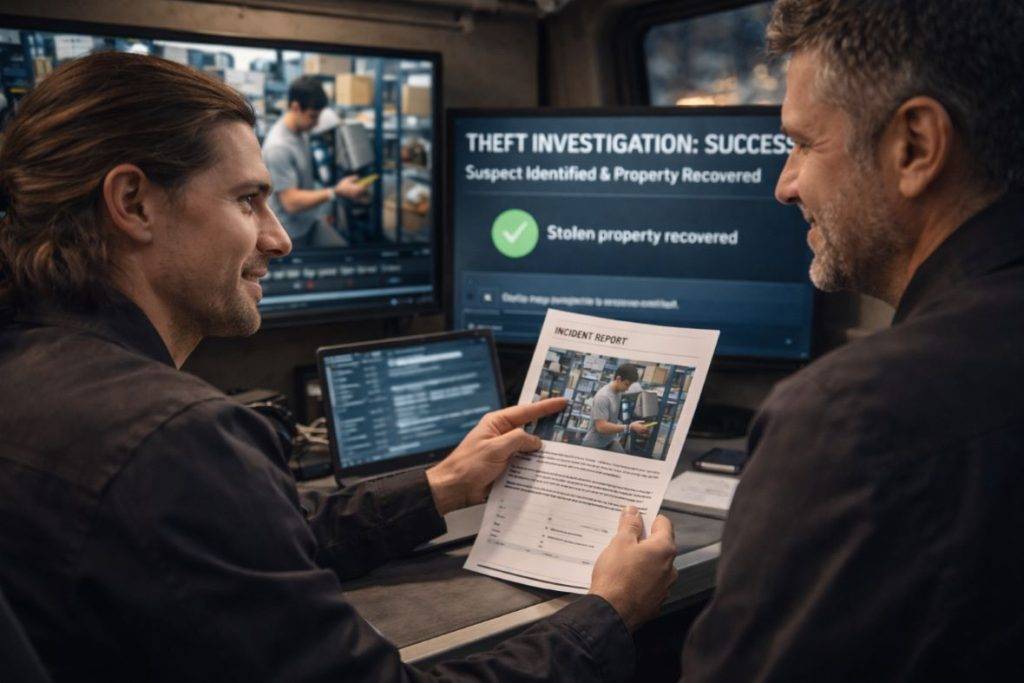
When you’re dealing with missing stock, cash loss, or suspected fraud, a Private Investigator can help you find what happened and document it clearly. The key is to stay within Australian laws on privacy, recording, and surveillance, so your evidence remains usable.
Verify licensing, agree on scope, and keep the work discreet and fair. Your best next step is practical: write down the timeline, secure the records and CCTV you already have, then speak with a licensed investigator about conducting loss and theft investigations with a carefully planned approach.
FAQ: Hiring a Private Investigator for Loss and Theft Investigations in Australia
How long does a loss and theft investigation usually take?
It depends on whether the theft is a one-off or a repeat pattern. If you have strong records and a clear timeframe (for example, shortages started after a roster change), it can move quickly. Some matters wrap in a few days, others take a few weeks when surveillance is needed to confirm timing and method. Delays usually come from limited access to systems, missing CCTV exports, or shifting accounts from staff and contractors.
What should you give a Private Investigator to start the case?
Start with a clear timeline, who had access, and what controls are in place. Provide relevant policies, inventory and sales records, and any footage you already control. Share names of key contacts who can approve access to sites, systems, and documents. Don’t confront a suspect on impulse, and don’t “test” staff by making traps that could confuse the facts. Preserve records as they are, and agree on a plan before you act.
Will the evidence stand up if the matter goes to court or the police?
Evidence is more substantial when it’s collected lawfully, appropriately documented, and handled carefully from the start. A Private Investigator can help you build a clear, factual brief with exhibits and a timeline, which makes it easier for lawyers, insurers, or police to assess. Outcomes still depend on the forum and the facts. Illegal recording or privacy breaches can weaken your position and create new problems, even if theft did occur.