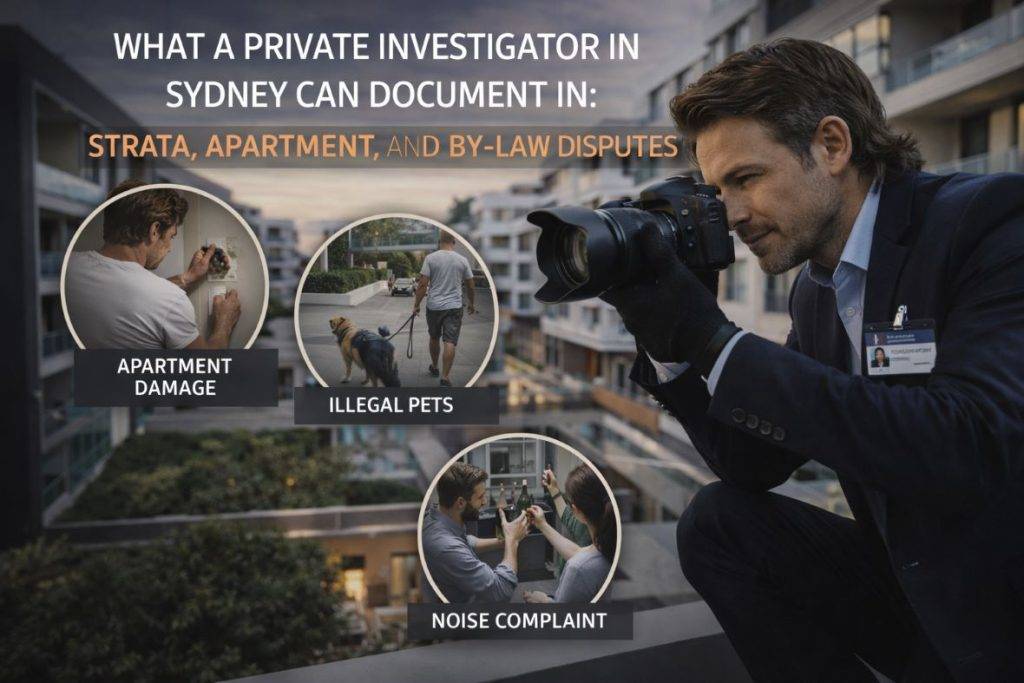
In Sydney strata disputes, people often argue about what happened, how often it happened, and whether it actually breached a by-law. That is why evidence matters. NSW strata by-laws commonly address noise, parking, smoking, pets, and short-term rental accommodation, and most strata disputes must go through NSW Fair Trading mediation before reaching NCAT. A private investigator in Sydney can help by documenting patterns, timing, and conducting the investigation lawfully, especially when the issue recurs, and ordinary diary notes are no longer sufficient. (NSW Government)
The important word is lawful. In New South Wales, secret audio recording and certain covert optical surveillance can pose legal problems. The Surveillance Devices Act 2007 regulates listening devices and optical surveillance devices, and also restricts possession of records obtained in breach of those rules. In strata matters, that means “good evidence” is not just evidence that looks persuasive. It also has to be gathered in a way that does not create a second dispute about how it was obtained.
Why do strata disputes so often turn into evidence disputes
Most apartment and by-law conflicts do not begin with a clear single incident. They usually develop through repetition. A car keeps parking in visitor spaces. Noise happens late at night, but not every night. Smoke drifts into another lot at irregular times. Short-term guests keep using lifts, parking areas, and common entry points in ways residents notice but struggle to prove. NSW guidance is clear that common strata by-laws often cover parking, noise, smoking, pets, and short-term rental accommodation, while the model by-laws in the Regulation include rules about noise and smoke penetration into common property or another lot.
That is where a private investigator in Australia becomes useful. The role is not to “spy” on private life. The role is to document observable conduct linked to the actual issue in dispute. In many cases, the most valuable thing an investigator produces is not dramatic footage. It is a reliable chronology showing what occurred, where it occurred, how often it occurred, and whether it happened on common property, in shared access areas, or in a way visible from a lawful vantage point.
The first thing that must be checked: the actual by-law
Before any evidence-gathering begins, the relevant by-law should be identified. That sounds obvious, but it is one of the most common weaknesses in strata disputes. NSW says strata by-laws govern the scheme, while common by-laws address pets, smoking, short-term rental accommodation, parking, and noise. If the dispute is really about parking, smoking, or behaviour on common property, the evidence should be built around the wording of that by-law and not around general annoyance alone.
There is also a broader statutory rule in section 153 of the Strata Schemes Management Act 2015, which says owners, tenants, occupiers, and others must not use or enjoy a lot in a way that causes a nuisance or hazard to another occupier, or unreasonably interferes with another person’s use and enjoyment of common property or another lot. That matters because some disputes are not just about a narrowly worded by-law. They may also raise nuisance issues under the Act itself. (AustLII)
What a private investigator can usually document lawfully
1. Repeated conduct on common property
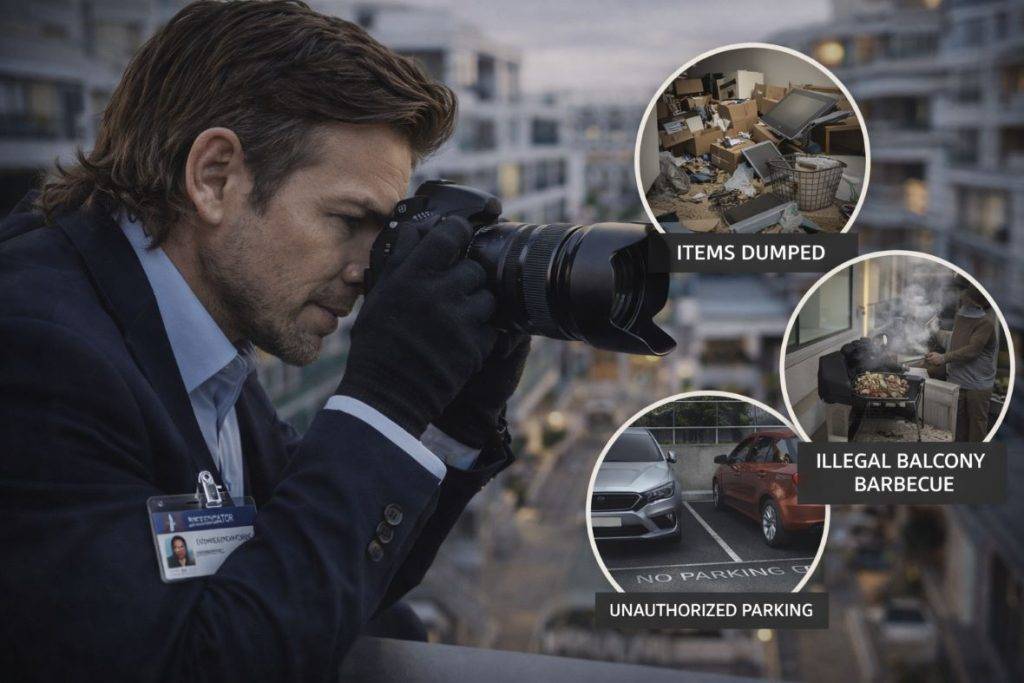
A private investigator can often document repeated conduct in places such as lobbies, lift foyers, entrances, visitor parking areas, bin rooms, loading zones, common hallways, and other common-property areas, provided the observation is done lawfully and without trespass. In strata disputes, common property is often where the pattern becomes visible: repeated misuse of visitor parking, smoking in prohibited areas, rubbish dumping, after-hours common-area gatherings, or short-term guest turnover. NSW strata materials make clear that parking, noise, smoking, and behaviour on common property are common by-law topics. (NSW Legislation)
This kind of documentation is often more useful than a resident’s one-off phone photo because it can show pattern and frequency. In practice, pattern is usually what moves a matter from “complaint” to “evidence.”
2. Parking misuse and vehicle-related by-law breaches
Parking disputes are one of the clearest examples of where private investigative evidence can help. NSW says strata by-laws commonly deal with parking, and parking disputes are specifically recognised as a regular strata issue. If the complaint is that a resident, visitor, contractor, or short-term guest repeatedly occupies visitor parking, blocks access, or misuses common parking areas, an investigator can document dates, times, durations, vehicle descriptions, repeated recurrence, and the precise area being affected. (NSW Government)
That kind of evidence is especially useful where a building already knows who is likely responsible but still needs objective proof of how often the conduct happens.
3. Noise-related patterns, but not secret audio shortcuts
Noise is one of the most common strata complaints in NSW, and model by-laws say an owner, occupier, or invitee must not create noise on a lot or common property that is likely to interfere with another person’s peaceful enjoyment. NSW guidance also lists barking dogs, loud music, power tools, alarms, construction, and noisy cars among common strata noise complaints. (NSW Legislation)
A private investigator can help document the timing, duration, source location, movement patterns, gatherings, and associated behaviour around repeated noise complaints, especially where the issue spills into common property or is externally observable. What they should be very careful about is covert audio recording. In NSW, the Surveillance Devices Act restricts the use of listening devices for private conversations and the possession of records obtained in breach of the Act. So in a noise dispute, the safer evidence is often timing, location, contemporaneous notes, lawful video from a proper vantage point, and corroboration with residents’ records, rather than risky secret sound recording. (NSW Legislation)
4. Smoking and smoke-drift patterns tied to common areas or visible conduct
NSW’s model by-laws include smoking rules. One model option says an owner or occupier must not smoke on common property and must ensure smoke from their lot does not penetrate common property or another lot. NSW also notes that strata by-laws often deal with smoking, and tenants as well as owners must follow the by-laws that apply in the scheme. (NSW Legislation)
A private investigator is not there to prove the chemistry of smoke. But they can document visible smoking on common property, recurring balcony use linked to smoke complaints, timing patterns, and whether the conduct aligns with the complaint history. In a smoke-drift matter, the evidence is often strongest when investigator observations are combined with resident diaries, complaint logs, and the actual scheme by-law wording.
5. Short-term letting indicators in common areas
Short-term rental disputes can be difficult because residents often complain about turnover, security, noise, luggage movement, extra access activity, and non-resident use of common facilities before the scheme can prove what is happening. NSW identifies short-term rental accommodation as a common by-law topic. In practice, a private investigator can sometimes document repeated guest turnover, key handovers in common areas, luggage movement, lobby access patterns, and recurring short-stay behaviour visible from lawful common-property observation points. (NSW Government)
The point here is not to invade anyone’s lot. It is to document common-area patterns that support or contradict the claim that the apartment is being used in a way inconsistent with the scheme’s rules.
6. Use of common property contrary to scheme rules
Some strata disputes are less about a single dramatic breach and more about misuse of shared areas: goods left in hallways, repeated unauthorised storage in common areas, obstructive use of access zones, rubbish room misuse, or invitee behaviour that keeps recurring. The model by-laws include rules on behaviour on common property, fire safety, storage of inflammable substances, and conduct likely to interfere with others. (NSW Legislation)
Where those issues are ongoing, an investigator can document recurrence, timing, the specific location on common property, and whether the conduct appears isolated or systematic. That can be especially useful before a formal section 146 Notice to Comply is issued, because the notice should describe the alleged contravention clearly and attach the by-law said to be breached. (NSW Government)
What a private investigator should usually not document in a strata dispute
This is where strata clients often get it wrong. They assume the more invasive the evidence, the stronger it is. Often the opposite is true.
A private investigator should usually avoid covert audio recording of private conversations, hidden-camera recording of private activity, or intrusive conduct inside a person’s lot without proper legal authority. NSW’s Surveillance Devices Act regulates listening devices and optical surveillance devices, and the law does not become optional just because the dispute is “only strata.” (NSW Legislation)
That means a Sydney strata investigation should usually focus on:
- common property
- public or lawfully accessible vantage points
- visible conduct
- repeated timing and pattern evidence
- photographs or video gathered without unlawful covert intrusion
- diary-style chronology and corroboration
The strongest strata evidence is usually boring, precise, and repetitive. That is often exactly why it works.
How investigative evidence fits into the strata process
NSW Fair Trading says strata disputes can often be resolved through discussion, complaints pathways, and mediation, while NCAT says mediation is compulsory for most strata and community scheme disputes before lodging an application. NCAT also says applicants generally need to attach evidence of mediation to their application unless exempt. (NSW Government)
That matters because investigative evidence is rarely the very first step. More often, it strengthens the file once a complaint has stalled, a pattern is denied, or a committee or owners corporation needs objective material before issuing a notice to comply or deciding whether to proceed further. Under the Strata Schemes Management Act, section 146 addresses a notice by an owners corporation to an owner or occupier, and section 147 addresses civil penalties for breaches of by-laws. NCAT’s strata orders material also notes that supporting documents may be required depending on the order sought. (NSW Legislation)
In simple terms, evidence helps the dispute move from “they keep doing it” to “this is what happened, this is when it happened, and this is the rule it appears to breach.”
What makes strata evidence more persuasive
For Sydney apartment and by-law disputes, persuasive evidence is usually:
- tied to a specific by-law or statutory obligation
- date- and time-stamped
- gathered over more than one occasion where pattern matters
- limited to lawful observation areas
- consistent with other records such as complaint logs, access records, or resident diaries
- presented clearly enough for mediation, committee review, or NCAT material
Investigators help most when they reduce ambiguity. They are not there to create drama. They are there to clarify whether the complaint is isolated, exaggerated, repeated, or objectively supportable.
Conclusion
A private investigator in Sydney can be useful in strata, apartment, and by-law disputes when the real problem is not a lack of complaint, but a lack of proof. In common-property and recurring-conduct matters such as parking misuse, noise patterns, smoking breaches, short-term letting indicators, and repeated behavioural issues, a lawful investigation can help document what is actually happening and how often. NSW strata law already provides the framework: by-laws regulate many everyday apartment issues; section 153 covers nuisance and unreasonable interference; section 146 allows a notice to comply; and most disputes must first go through mediation before NCAT. (NSW Government)
The key is restraint. The best strata evidence is usually not the most invasive. It is the most accurate, the most relevant to the by-law, and the most clearly documented.
FAQs
1. Can a private investigator record sound in a Sydney strata dispute?
Usually, that is the risky part. In NSW, the Surveillance Devices Act regulates listening devices used for private conversations and also restricts possession of records obtained in breach of the Act. In many strata matters, lawful observation, timestamps, photos, and video from proper vantage points, along with a diary-style chronology, are safer than covert audio. (NSW Legislation)
2. What strata issues are most suited to private investigative evidence?
Recurring common-property issues are usually the best fit, such as visitor parking misuse, repeated smoking on common property, short-term letting indicators in shared areas, repeated nuisance behaviour, and visible conduct linked to noise or misuse of common facilities. NSW says common strata by-laws often deal with parking, noise, smoking, pets, and short-term rental accommodation. (NSW Government)
3. Do strata disputes usually have to go through mediation first in NSW?
Yes, in most cases. NCAT says mediation is compulsory for most strata and community scheme disputes before applying to the Tribunal, and applicants generally need to attach evidence of mediation unless exempt. (NSW Civil and Administrative Tribunal)
References
NSW Civil and Administrative Tribunal. Strata schemes. https://ncat.nsw.gov.au/case-types/housing-and-property/strata-and-community-living/strata-schemes.html
NSW Civil and Administrative Tribunal. Strata schemes fact sheet. https://ncat.nsw.gov.au/documents/factsheets/ccd_factsheet_strata_schemes.pdf
NSW Civil and Administrative Tribunal. Strata schemes orders. https://ncat.nsw.gov.au/case-types/housing-and-property/strata-and-community-living/strata-schemes/strata-schemes-orders.html
NSW Fair Trading. Strata by-laws. https://www.nsw.gov.au/housing-and-construction/strata/living/by-laws
NSW Fair Trading. Strata disputes. https://www.nsw.gov.au/housing-and-construction/strata/disputes
NSW Fair Trading. Noise in strata. https://www.nsw.gov.au/housing-and-construction/strata/living/noise
NSW Fair Trading. Strata parking rules. https://www.nsw.gov.au/housing-and-construction/strata/living/parking
NSW Government. Renting in strata. https://www.nsw.gov.au/housing-and-construction/renting-a-place-to-live/renting-strata
NSW Legislation. Strata Schemes Management Act 2015. https://legislation.nsw.gov.au/view/html/inforce/current/act-2015-050
NSW Legislation. Strata Schemes Management Regulation 2016. https://legislation.nsw.gov.au/view/whole/html/inforce/2024-07-04/sl-2016-0501
NSW Legislation. Surveillance Devices Act 2007. https://legislation.nsw.gov.au/view/html/inforce/current/act-2007-064
NSW Fair Trading. Notice to Comply with a By-Law. https://www.nsw.gov.au/sites/default/files/2022-03/notice-to-comply.pdf